
Are we there yet? Why clarity matters in council improvement and recovery programmes
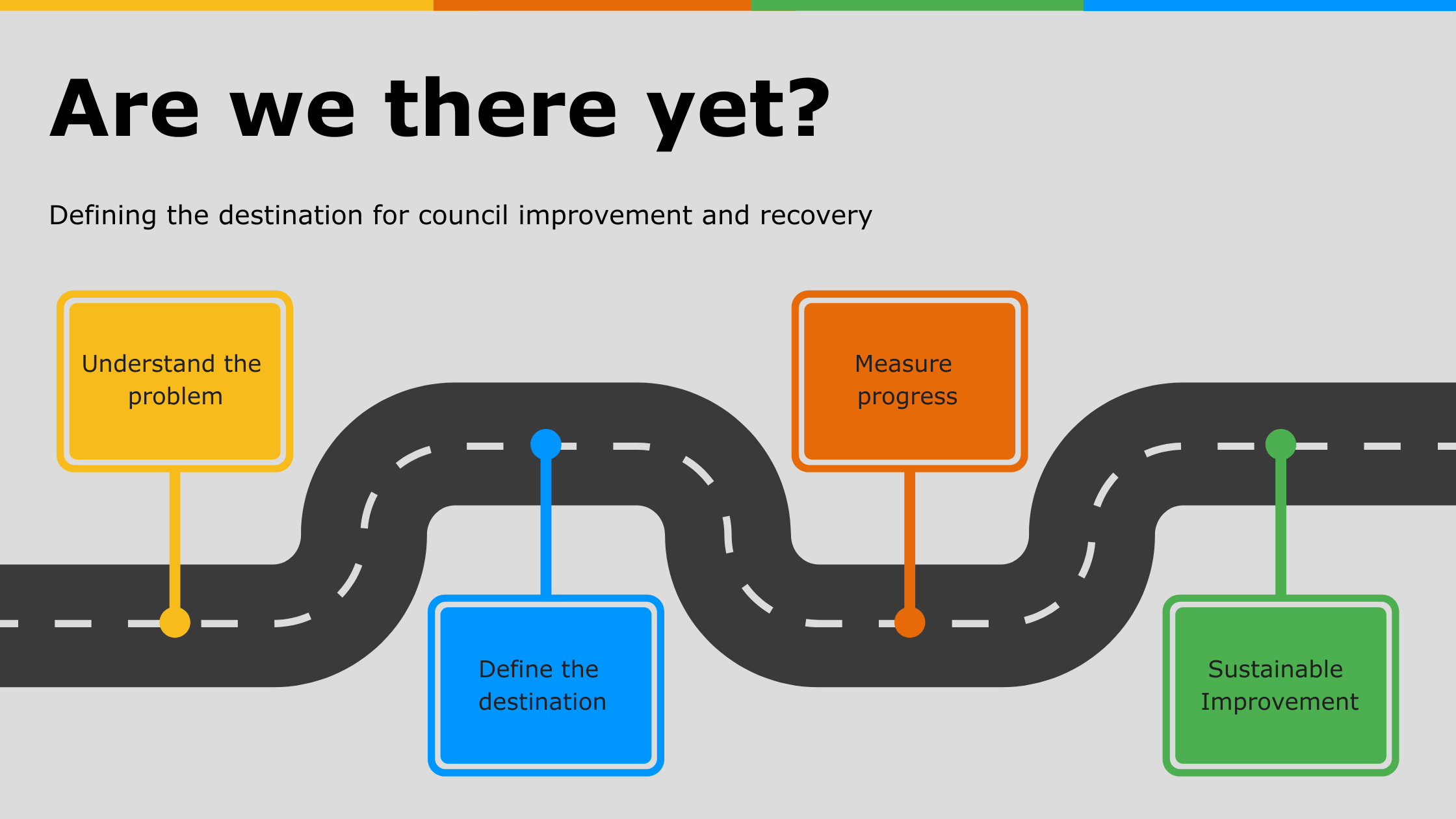
Defining the destination for council improvement and recovery
When a council is facing significant improvement or recovery challenges, the pressure to act can be intense. That pressure is even greater where government-appointed Commissioners are involved, external scrutiny is high, or an authority is preparing for a major change programme to address governance, finance, performance, culture or service delivery.
In those circumstances, it is natural to want to move quickly: produce the plan, mobilise the programme, demonstrate progress and reassure stakeholders that action is being taken.
But before setting off, a key question to ask is: do we know where we are trying to get to?
Starting with the destination
Most journeys need a destination. Without one, it is difficult to plan the route, bring people with you, judge progress or know when you have arrived. Improvement and recovery programmes are no different.
Those leading the programme need to be able to describe, clearly and consistently, what success looks like. This involves more than listing actions, projects or workstreams. It means defining the intended end state: the outcomes the programme is designed to achieve and the difference it should make for residents, members, staff, partners and, in some cases, government.
The clearer that destination is from the outset, the easier it becomes to:
Build shared understanding across the organisation
Align political and managerial leadership
Prioritise effort and resources
Reduce false starts and duplication
Give staff and partners confidence in the direction of travel
Track progress meaningfully
Recognise when the programme has delivered what it set out to achieve
However, having defined the destination, there is another critical step that is often overlooked: understanding the problem or problems you are trying to solve.
Understanding the starting point: the problem you are trying to address
Unlike most physical journeys, where the purpose is usually clear, identifying the right destination for an improvement or recovery journey requires clarity about why the journey is needed.
What are the problems the council is trying to solve? What is it trying to improve or recover from?
Often, the symptoms of a problem are visible, but the root causes can be much harder to identify. For example, concerns about governance may be linked to unclear accountabilities, organisational culture, leadership behaviours, capacity constraints or long-established ways of working.
Financial challenges may stem from decision-making, service design, demand pressures or organisational priorities, rather than finance alone. Understanding these underlying factors is vital because improvement programmes that focus solely on symptoms can struggle to deliver lasting change.
Councils facing government-appointed Commissioners are often working from Directions or Commissioner recommendations. These provide an important description of the issues that need to be addressed, but they do not always fully capture why those issues emerged in the first place.
As Barry Scarr, Government-appointed Finance Commissioner for Woking Borough Council and Spelthorne Borough Council, explains:
“As a government-appointed Commissioner who has worked with a number of councils in intervention, it is those that take the time to really understand the root causes of their problems and clearly define their destination that are most successful.”
Time invested at the outset to identify and agree the problems to be solved, and then define and communicate the target end state, is not a delay. It is one of the most important foundations for delivery. Only when there is clarity about the problems can there be meaningful agreement about the outcomes.
Moving from activity to outcomes
Improvement and recovery programmes often involve a great deal of activity. New boards are established, plans are written, reviews are commissioned, workstreams are created and action trackers fill up quickly.
All of that may be necessary. But activity is not the same as progress. The real test is whether the programme is delivering the outcomes the council needs.
Some outcomes are relatively easy to define. For example, reducing monthly customer complaints by a specified percentage over a defined period gives the organisation a clear target. It allows teams to design interventions, collect data, monitor impact and know whether the intended change has been achieved.
Other outcomes are harder to define. Councils may want to improve culture, strengthen accountability, improve decision-making or build better collaboration. These are important ambitions, but they can be difficult to deliver if they remain broad statements of intent.
If the outcome is not clearly defined, the delivery plan can quickly become a list of things to do rather than a route to meaningful change.
Teams may work hard, produce outputs and complete actions, but still be left uncertain about whether the programme has delivered the change required. That is where councils can lose time, energy and confidence.
Why this matters in intervention, improvement and recovery
Clarity matters in any change programme. It matters even more in an improvement or recovery context.
When a council is under pressure, there is often an understandable desire to demonstrate early momentum. Leaders may feel they need to show that a plan is in place, meetings are happening and activity is underway.
But if the destination is unclear or the root causes are not well understood, early momentum can take the organisation in the wrong direction.
A strong improvement or recovery programme needs to answer some straightforward but challenging questions:
What does good look like?
What are we trying to change, and why?
How will residents, members, staff, partners and regulators experience that change?
What evidence will tell us that progress is being made?
What will be different when the programme has succeeded?
How will we know when we are there?
If asked, would all key stakeholders answer these questions in the same way?
These are not academic questions. They are practical delivery questions. They help turn broad ambition into a programme that can be understood, managed and measured.
Helping councils define, deliver and evidence improvement
At Newtrality, we support councils that are establishing or running significant recovery and improvement programmes, including councils in intervention and those working with government-appointed Commissioners.
Our role is to help councils create clarity where the environment may feel complex, pressured or uncertain.
That can include helping leadership teams and stakeholders to:
Define the target operating position or end state
Turn broad improvement ambitions into specific outcomes
Develop meaningful measures of progress
Align plans, governance and reporting around the outcomes that matter
Test whether stakeholders share the same understanding of success
Identify gaps, duplication or ambiguity in current improvement activity
Create practical delivery frameworks that support pace without losing focus
We bring structure, challenge and experience to help councils develop and deliver their improvement plans. Each council’s context is different, so the work and the plan must reflect the authority’s specific challenges, statutory responsibilities, political environment, workforce, communities and partners.
The aim is not simply to produce a better plan. It is to help councils build a clearer route to sustainable improvement.
So, are we there yet?
If you are responsible for, involved in or supporting an improvement or recovery programme, it may be worth pausing to ask:
Are we clear about the underlying problems we are trying to solve?
Can we clearly describe the end state we are working towards?
Would our key stakeholders describe it in the same way?
Have we defined how progress will be measured?
Are our plans focused on outcomes, rather than activity?
Do we know what evidence will show that the programme has delivered?
Can we confidently answer the question: what does “done” look like?
If the answer to any of these questions is unclear, it may be time to step back and revisit both the reason for the journey and the destination.
Newtrality helps councils diagnose the challenges behind improvement and recovery programmes, define a shared destination and translate it into a practical, measurable plan for delivery.
If your council is establishing, reviewing or refocusing an improvement or recovery programme, get in touch with our team for an initial conversation about where greater clarity could strengthen delivery.
The strongest programmes do not simply ask, “Are we there yet?” They understand why the journey is needed, where they are going and what successful arrival will look like.